Wednesday, March 18, 2015

Characterization Exercise


1. Find a picture of a person (from a magazine or newspaper).

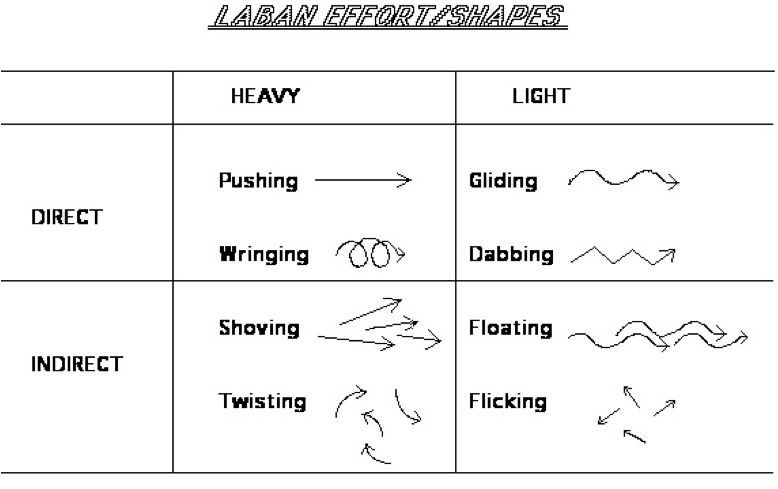
2. Create a physical characterization of this person using Laban's analysis of different types of effort/shape.

3. Find a gesture that expresses this person's personality.

4. Make up a sentence for this person. It can be something quite simple (e.g. "Oh dear, it's sunny now but it'll probably rain later because life is like that."

5. On Thursday you will show the class your physical characterization, gesture and sentence.

For those of you who didn't record the chart from class, here is one I found online.


Friday, March 13, 2015

Viewpoints Reflection

Viewpoints is a technique of composition that provides a vocabulary for thinking about and acting upon movement and gesture. Originally developed in the 1970s by choreographer Mary Overlie as a method of movement improvisation, The Viewpoints theory was adapted for stage acting by directors Anne Bogart and Tina Landau. Bogart and Overlie were on the faculty of ETW at NYU in the late 1970s and early 1980s during which time Bogart was influenced by Overlie's innovations. Overlie's Six Viewpoints (space, story, time, emotion, movement, and shape) are considered to be a logical way to examine, analyze and create dances, while Bogart's Viewpoints are considered practical in creating staging with actors. (from wikipedia)

Reflect on your experience with Viewpoints thus far.

1. What do you like about Viewpoints?

2. Where there any moments that felt particularly alive for you?

3. Where there times when the activity felt dead and forced? If so why and when?


Thursday, March 5, 2015

Body Learning 2 - Due Sunday March 8th

Book Report: Body Learning Part 2

300-500 words
Blog Post

  • Summarize: Primary Control, Unreliable Sensory Appreciation, Inhibition, Direction, Ends and Means
  • Reflection: What did you find interesting, helpful, confusing, etc. about the reading?

Friday, February 27, 2015

Body Learning - Part 1 (Due Tuesday March, 3rd)

We have been talking the past week about the Alexander Technique. F.M. Alexander once said, "This work is so simple. The trouble is, it’s too simple.” What exactly is it? In brief:
The Alexander Technique is method of  learning how to move mindfully through life. The Alexander process shines a light on inefficient habits of movement and patterns of accumulated tension, which interferes with our innate ability to move easily and according to how we are designed. It’s a simple yet powerful approach that offers the opportunity to take charge of one’s own learning and healing process, because it’s not a series of passive treatments but an active exploration that changes the way one thinks and responds in activity. It produces a skill set that can be applied in every situation. Lessons leave one feeling lighter, freer, and more grounded. (http://www.alexandertechnique.com/at.htm)
For this blog post, I have asked yo to read pages 1-41 of Body Learning, by Michael Gelb. You can find the reading on Moodle. Please write 300-500 words on the following questions:
a. Summarize the life of F.M. Alexander


b. Summarize the first two operational ideas: Use and Functioning, The Whole Person (please include a quote that best captures the key idea behind each concept) 

Tuesday, February 17, 2015

Alexander Technique - Due February 22nd

We are moving on in class to talk about the Alexander Technique. One of its key principles is that human beings have the ability to change the ways in which we use our bodies. The Alexander Technique is a way to gain conscious control over ourselves and thereby overcome many of the unhelpful habits we have accumulated over the years. In short, it is all about freedom! The key to gaining this freedom is (yes, you guessed it) awareness/mindfulness!!!

To reap the benefits of the Alexander Technique (and Yoga..and life for that matter...) AWARENESS is absolutely essential! But how do I become more aware? Simply be being aware. The following video is by an Indian psychologist and spiritual writer named Anthony De Mello. He wrote an incredible book called "Awareness" which changed my life when I read it four years ago. The following clip is a short segment from that book called "self-observation."


Video 1: Anthony De Mello on "Self-Observation"


1. What is the most important thing you can do when no one can help you?

2. What is the difference between self-observation and self-absorption? What is self-observation?

3. Why do we suffer?

4. Anthony De Mello uses the analogy of the sky and clouds to speak about the relationship between our true "self" and our thoughts/emotions/different states of life. How does he define the the self/"I"?

5. If you understand things they will do what?

6. Finish the sentence from 5.25: "What you judge you ...."


Reflection: 

7. What do you think about DeMello's statement, "I am not my depression, I am not my joy?" Who/What is the "I" that can say, "I am not myself?" Make a list of your most precious qualities and character traits. Does that list account for everything that is your "I?" If not, why not?


In the next video, an Alexander teacher named Angela Bradshaw offers a very short introduction to the Alexander Technique. It is impossible to understand what she is saying without standing up and trying out these ideas on your own body. Therefore please watch this video once and follow her directions. Watch a second time and answer the following questions. 


Video 2: Ted Talk by Angela Bradshaw on the "Alexander Technique"


1.  What happens to us when we experience fear, stress and anxiety? Why?

2. (minute 3.15ish) The Alexander Technique does what?

3. Finish the sentence (4:10ish) "Nature would prefer...."

4. What are the three points of contact for the foot?

5. What are the three hinges in our legs?

6. Where are the hip joints?

7. Allow the pelvis to be heavy like a .....?

8. Where is the top of the spine?


Reflection:

9. What, according to your view of the world, is the connection between your mind and body?


Thursday, February 5, 2015

Fourth Post: Getting out of your own way

This week we spoke a bit about the notion of flow. Flow is a concept coined by a psychologist named Dr. Mihaly Csikszentmihaly (I told you his name was hard to pronounce). Flow, also known as the "zone" is the mental state in which a person performing an activity is fully immersed in a feeling of energized focus and full involvement. Happiness for Csikszentimhaly is not a static state but rather, the experience of being in flow. In short, flow is characterized by complete absorption in what one is doing in the present moment.

Here is an image of his Performance Flow Chart. To summarize what we said on Tuesday, when one's skill is greater than the challenge, the result is boredom. When the challenge is greater than the skill, the result is anxiety. When the activity provides little challenge and requires little skill, the result is apathy.


This idea of happiness is very much in line with Zen. Shunryu Susuki for instance, in his great book Zen Mind Beginner's Mind, says: "When you do something, you should burn yourself up completely, like a good bonfire, leaving no trace of yourself."

Questions:

Video 1 - Playing the Game of Life, by Alan Watts

Note: Alan Watts was a scholar and speaker who wrote extensively on Zen back in the 60's and 70's.

1. What does our society tell children?

2. What is our society's "preparation for life?"

3. When one arrives, Watts claims that he or she often feels cheated. Why?

4. What is the final goal of our society?

5. What is the problem with living ever for the future?

Video 2: The Secret of Life 

1. What is the Chinese word for nature? What does it mean?

2. According to Watts, you stop the spontaneous flowering of nature if you do what to it?

3. According to Watts, what are human beings?

4. What is the secret of life according to Watts?

Video 3: You're Already Awesome

Note: Dr. Judson Brewer is a professor at Yale University's department of psychiatry.

1. What was Dr. Brewer's experience of flow?

2. According to the Harvard study mentioned by Brewer, what percentage of time do we get caught of up thinking?

3. Finish the sentence: "A wandering mind is a  _____"

4. What happens to the brain during meditation?

5. In nine minutes, the test subject mentioned by Brewer learned the difference between what?

Reflection Question:

Reflection question: How does all of this relate to our yoga practice? How does it relate to killer ball? To performing? Was there an idea in any of these talks that stood out to you? If so, what was it and why?

(If you think that all of this is nonsense, please share those thoughts too! Don't feel like you ought to say things simply to get a good grade. I love it when students say, "I think this is a bunch of crap." Feel free to speak your mind!)


Wednesday, January 28, 2015

Third Post: Mindfulness (Due February 1st)

This week we spent some time talking about mindfulness. On Moodle, I have posted two short youtube clips about mindfulness.

(Video 1) What is Mindfulness - Dr. Jon Kabat-Zinn

  1. How does Dr. Kabat-Zinn define mindfulness?
  2. Why, according to Dr. Kabat-Zinn, does our "life depend" upon mindfulness?
  3. Does it matter what thing or things you pay attention to?
  4. Is Mindfulness a technique? 

(Video 2) All it Takes is 10 Mindful Minutes - Andy Puddicombe

  1. What does Andy suggest we "do" for at least 10 minutes each day?
  2. According to the Harvard study cited by Andy, what % of time are our minds lost in thought?
  3. Is Mindfulness about controlling our thoughts and feelings? If yes, explain. If not, explain.
  4. How does Andy's juggling with the three red balls relate to our activity of balancing sticks?
Reflection

Give yourself 10 minutes to try a very simple mindfulness/meditation practice. Set an alarm on your phone so that you don't have to continually check the time. 

The following directions may be helpful. Please share a few sentences reflecting upon your experience. 

  • Find a comfortable seat, either sitting in a chair or cross-legged on the floor. The important thing is that your spine is straight.
  • Give yourself permission to take these few minutes for yourself - to simple be fully present to the moment. Make an intention if you so wish.
  • Bring your attention to your breath. Relax your shoulders, your jaw, and your belly. Release anything you are holding on to. Allow the body to open and release.
  • Observe your natural inhalations and exhalations. Witness the breath as it enters into your body, filling your lungs and body. Witness each out-breath as it leaves your body and dissipates into space.
  • Your mind will probably become flooded with thoughts before too long. You may become aware of pain in your body. Perhaps you will feel restless, anxious, or bored. You will begin to tell yourself stories about your thoughts, feelings, and sensations.
  • Do not judge these thoughts, feelings or emotions. Simply notice them and then return your awareness to your breath. Imagine that these thoughts, feelings and emotions are like clouds floating in the sky. Let them pass.
  • It's a simple as that.